As Enterprise Ethereum moves from experimentation to production, privacy lies at the center, shaping what comes next.
While mature privacy technologies exist across the Ethereum ecosystem, institutions lack structured clarity. They need a framework to evaluate approaches, understand trade-offs, and determine which models align with regulatory, operational, and fiduciary requirements.
The EEA Privacy Working Group was established to address this need for clarity.
Institutional Drivers for Privacy in Ethereum Deployments
Financial institutions and enterprises are no longer debating whether to deploy on Ethereum, but rather how to do so. Privacy is the critical factor determining whether deployment advances from pilot to production.
Institutional deployment demands robust confidentiality. For example, a bank tokenizing assets on Ethereum must ensure transaction privacy so that counterparties, amounts, and instrument details are not visible to all participants. A regulated fund using on-chain settlement must demonstrate compliance without disclosing sensitive position data. Similarly, an enterprise managing supply chain operations on Ethereum must protect proprietary business relationships while maintaining auditability and data integrity.
These are not exceptional cases; they are baseline requirements for institutions subject to fiduciary duty, data protection regulations, and competitive confidentiality constraints. Without privacy infrastructure, institutional Ethereum deployment cannot progress, regardless of advancements in other areas.
Participating Organizations
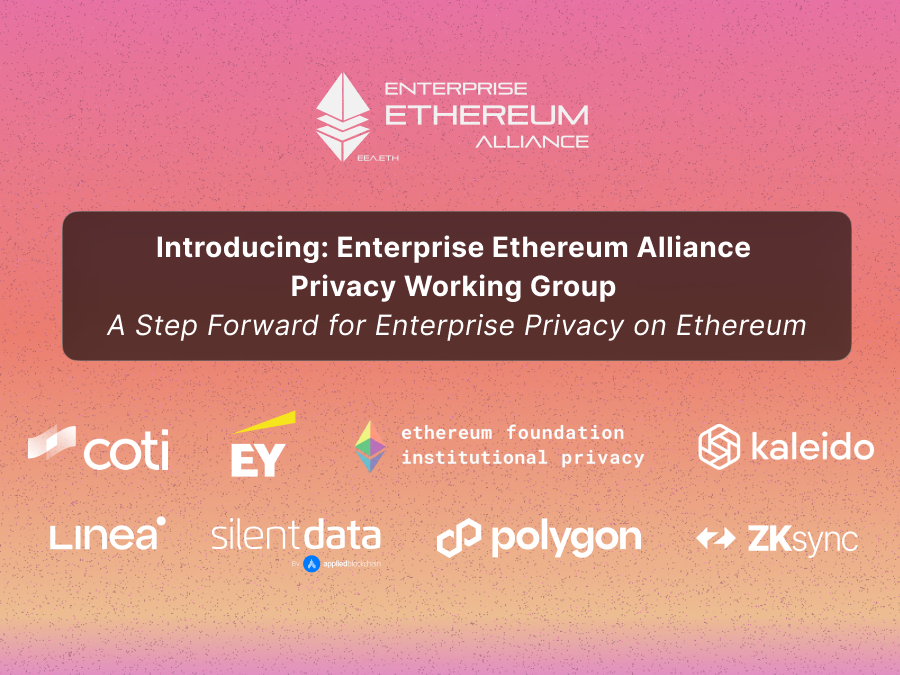
The Privacy Working Group unites organizations developing leading privacy solutions within the Ethereum ecosystem:
Applied Blockchain (Silent Data): confidential computing and trusted execution environments supporting privacy-preserving data verification.
Consensys (Linea): Layer 2 infrastructure designed to support enterprise deployments with privacy capabilities.
COTI: privacy-focused Layer 2 architecture purpose-built for confidential transactions and enterprise applications on Ethereum.
EY (Nightfall): zero-knowledge proof infrastructure enabling private transactions on public Ethereum, developed for enterprise use by one of the Big Four accounting firms.
Polygon: scalable Layer 2 infrastructure supporting institutional payment and settlement workflows with privacy considerations.
Kaleido (Paladin): privacy-preserving token transfer infrastructure designed for regulated enterprise environments.
ZKsync: zero-knowledge rollup technology enabling scalable, privacy-enhanced transaction execution on Ethereum.
The Ethereum Foundation’s Privacy & Scaling Explorations (PSE) team and Institutional Privacy Task Force (IPTF) are also contributing, providing perspective on the Ethereum mainnet privacy roadmap.
This is a collaborative initiative, not limited to a single vendor. It brings together expertise in confidential computing, zero-knowledge proofs, privacy-focused Layer 2s, and enterprise middleware, reflecting the range of approaches institutions must consider for production deployments.
What the Working Group Will Produce
The group’s initial mandate is to map the current landscape of enterprise-relevant privacy solutions across Ethereum mainnet and Layer 2 environments.
The result will be a structured publication that supports institutional decision-making by providing greater clarity and shared standards.
The publication will provide:
- A structured overview of available privacy approaches: what each technology enables, how it functions, and where it is currently deployed.
- Implementation considerations: operational, regulatory, and technical trade-offs translated for institutional decision-makers rather than protocol researchers.
- Deployment context: mapping privacy architectures to enterprise requirements including transaction confidentiality, regulatory compliance, auditability, and data protection.
The first version of this publication is in development. Due to rapid innovation in privacy infrastructure, the working group will update this resource regularly to reflect new technical developments, production deployments, and evolving regulatory frameworks.
From the Ethereum Foundation
“Privacy is one of the biggest remaining blockers to serious enterprise adoption of Ethereum. The Ethereum Foundation’s Privacy & Scaling Explorations team and the Institutional Privacy Task Force are focused on advancing open, interoperable privacy building blocks across the stack. We’re excited to see the EEA Privacy Working Group bring the ecosystem together.”
— Mo Jalil, Institutional Privacy Lead, Ethereum Foundation
The Ethereum Foundation’s participation marks an important shift. Privacy is becoming a core component of the protocol’s roadmap, rather than an external enterprise requirement. The EEA serves as the coordination layer, connecting evolving protocol capabilities with institutional implementation needs.
From the EEA
“The formation of this Privacy Working Group reflects the market’s transition toward real institutional deployment. The EEA’s role is to convene ecosystem leaders to coordinate privacy innovation while supporting Ethereum’s open ethos and enabling enterprise-grade confidentiality, compliance, and scalability requirements.”
— Redwan Meslem, Executive Director, Enterprise Ethereum Alliance
Implications for the Ethereum Ecosystem
Privacy is often described as a feature, but for institutions, it serves as essential infrastructure.
Organizations subject to regulatory oversight, fiduciary responsibility, and competitive pressures cannot deploy systems that make sensitive information broadly visible by default. Transaction details, positions, counterparties, and business relationships must be protected, while still enabling auditability, compliance, and interoperability.
Addressing these challenges requires more than individual technical solutions; it demands coordination. Institutions need shared standards, clear implementation pathways, and greater alignment among technology providers developing privacy solutions for Ethereum.
The EEA fulfills this role by providing a neutral forum where organizations can address these challenges collectively, supported by governance structures that enable cooperation while protecting intellectual property and competitive interests.
For enterprises evaluating Ethereum deployment, the privacy landscape is becoming clearer. The working group’s output will offer the structured clarity institutional decision-makers need to move from evaluation to production. The Privacy Working Group aims to accelerate this process by translating technical progress into practical guidance for production deployment.
Get Involved
The Privacy Working Group welcomes organizations interested in contributing to the development of enterprise privacy standards and implementation guidance for Ethereum.
Organizations building privacy infrastructure, deploying privacy-enabled solutions, or assessing institutional privacy requirements are encouraged to participate in the working group’s efforts.To learn more about contributing to the Privacy Working Group or joining the EEA, please get in touch with the EEA team directly.